5 Mistakes to Avoid While Doing Planks

Medically reviewed by Devanshi Modi, PT, Cert. MDT, CMP — licensed physical therapist with over 15 years of clinical experience.
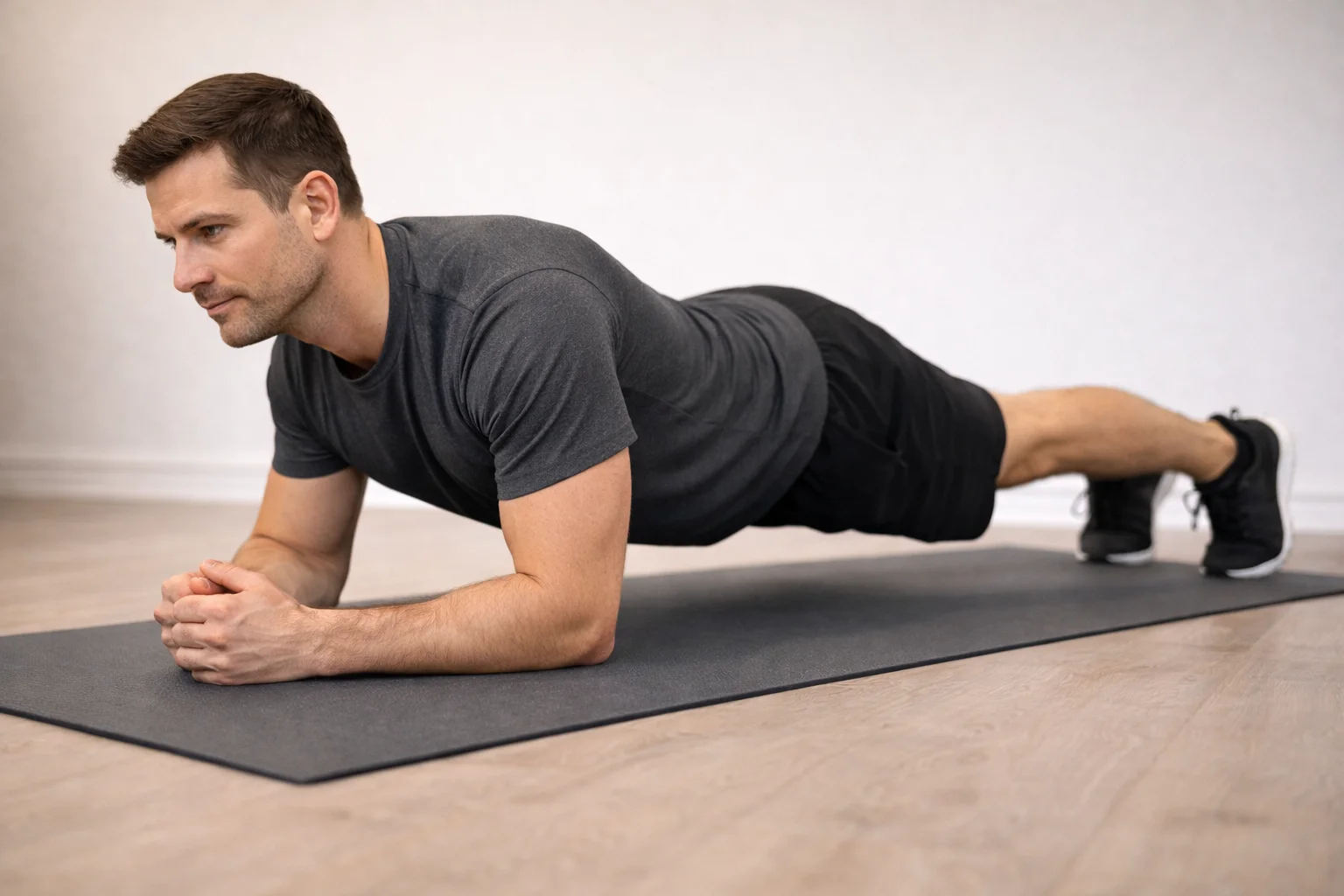
Here are 5 plank form mistakes we often see in our clinic, and how to correct them. The studies cited below are small lab studies, mostly in healthy young adults, that measured things like muscle activity rather than pain or injury, so think of these as practical form tips rather than proven rules.
1. Looking Straight Up
Keep your neck relaxed and in line with the rest of your spine, and look at the floor rather than lifting your head to look forward. This is how we coach the plank in our clinic; we could not find studies that have tested neck or head position during planks.
2. Too Much Strain on Shoulders
Place your elbows directly underneath your shoulders, and keep the tops of your shoulders (the upper trapezius muscles) relaxed and away from your ears. These are the setup cues we use in our clinic.
Aim to feel the work mainly in your belly muscles rather than the tops of your shoulders. One study supports the plank as a test of abdominal muscle endurance: in 30 healthy adults, of the abdominal, back and hip muscles measured, only the main belly muscle's (the rectus abdominis) rate of fatigue predicted how long people could hold the plank.[1] In another lab study of 20 university students, simply focusing on the belly muscles during a plank made the rectus abdominis work harder.[2]
3. Rounding of Upper and Mid Back
Keep your thoracic (mid back) spine flat rather than rounded up toward the ceiling. Where you hold your shoulder blades and pelvis also changes how hard your core works: in one lab study of 15 adults, several core muscles worked hardest when the shoulder blades were drawn together and the pelvis was tucked under, and this version also felt the hardest.[3]
4. Arching of Low Back
Avoid letting your low back sag toward the floor. Tucking your pelvis under (tilting it backward) made one of the side abdominal muscles (the external oblique) work harder than a standard plank in a lab study of 19 people,[4] and in another study, tucking the pelvis under with the shoulder blades drawn together made the abdominal muscles work harder than letting the pelvis tip forward into an arched low back.[3]
Gently draw your navel in toward your spine and keep your core engaged. In a lab study of 20 young adults, adding this "hollowing" move to a plank increased overall abdominal muscle activity, especially in the side abdominal muscles (the obliques), and also made the plank feel harder.[5]
Keep breathing throughout and do not hold your breath. In a lab study of 20 healthy adults doing a static (isometric) hand-grip exercise, holding the breath pushed blood pressure up more than breathing normally.[6] A plank raises blood pressure on its own, too: when 62 healthy, mostly young adults held a plank for as long as they could, almost all were stopped by the researchers after about 50 seconds on average, when their blood pressure passed a cautious cut-off used in exercise testing, although no harmful effects were reported.[7] If you have high blood pressure or a heart condition, ask your doctor how long you should hold a plank.
5. Hips Too Low
Avoid letting your hips sag. In our clinic, we cue patients to gently squeeze their buttock muscles to help keep the hips in line with the shoulders and the pelvis gently tucked under.
In our clinic, we often see good form at the start of a plank that slips as the hold goes on. Your core muscles tire as a plank continues: in a lab study of 15 healthy adults who held a plank as long as they could (about 2 minutes on average), effort ratings climbed from about the halfway point, and the main belly muscle showed growing fatigue in the second half of the hold.[8] So check your form toward the end of your hold, not just at the start. If your form slips before you reach your target time, it is fine to stop there and build up gradually.
To meet a certified McKenzie therapist in East Brunswick, call 551-208-3234 at Spineck Physical Therapy.
References
- De Blaiser C, De Ridder R, Willems T, et al. Evaluating abdominal core muscle fatigue: assessment of the validity and reliability of the prone bridging test. Scand J Med Sci Sports. 2018;28(2):391-399. doi:10.1111/sms.12919 · PubMed
- Calatayud J, Casaña J, Martín F, et al. Electromyographic effect of using different attentional foci during the front plank exercise. Am J Phys Med Rehabil. 2019;98(1):26-29. doi:10.1097/PHM.0000000000001008 · PubMed
- Cortell-Tormo JM, García-Jaén M, Chulvi-Medrano I, et al. Influence of scapular position on the core musculature activation in the prone plank exercise. J Strength Cond Res. 2017;31(8):2255-2262. doi:10.1519/JSC.0000000000001689 · PubMed
- Schoenfeld BJ, Contreras B, Tiryaki-Sonmez G, et al. An electromyographic comparison of a modified version of the plank with a long lever and posterior tilt versus the traditional plank exercise. Sports Biomech. 2014;13(3):296-306. doi:10.1080/14763141.2014.942355 · PubMed
- García-Jaén M, Cortell-Tormo JM, Hernández-Sánchez S, et al. Influence of abdominal hollowing maneuver on the core musculature activation during the prone plank exercise. Int J Environ Res Public Health. 2020;17(20):7410. doi:10.3390/ijerph17207410 · PubMed
- Watanabe H, Washio T, Saito S, et al. Effect of breath-hold on the responses of arterial blood pressure and cerebral blood velocity to isometric exercise. Eur J Appl Physiol. 2022;122(1):157-168. doi:10.1007/s00421-021-04822-1 · PubMed
- Jones MD, Tan E, Woo J, et al. Acute blood pressure responses to plank and wall sit isometric exercise in adults. J Hypertens. 2026;44(2):288-294. doi:10.1097/HJH.0000000000004191 · PubMed
- Cruz-Montecinos C, Bustamante A, Candia-González M, et al. Perceived physical exertion is a good indicator of neuromuscular fatigue for the core muscles. J Electromyogr Kinesiol. 2019;49:102360. doi:10.1016/j.jelekin.2019.102360 · PubMed
This article is for general education and is not a substitute for an individual evaluation by a licensed clinician.
Need Help With Your Condition?
If you're experiencing pain or have questions about physical therapy, schedule an appointment with our Certified McKenzie Therapist.
This article is for educational purposes only and is not a substitute for professional medical advice, diagnosis, or treatment. Always consult a licensed healthcare provider about your specific condition.