Why One-on-One Physical Therapy Can Make a Difference (And What to Ask Before You Book)

Medically reviewed by Devanshi Modi, PT, Cert. MDT, CMP — licensed physical therapist with over 15 years of clinical experience.
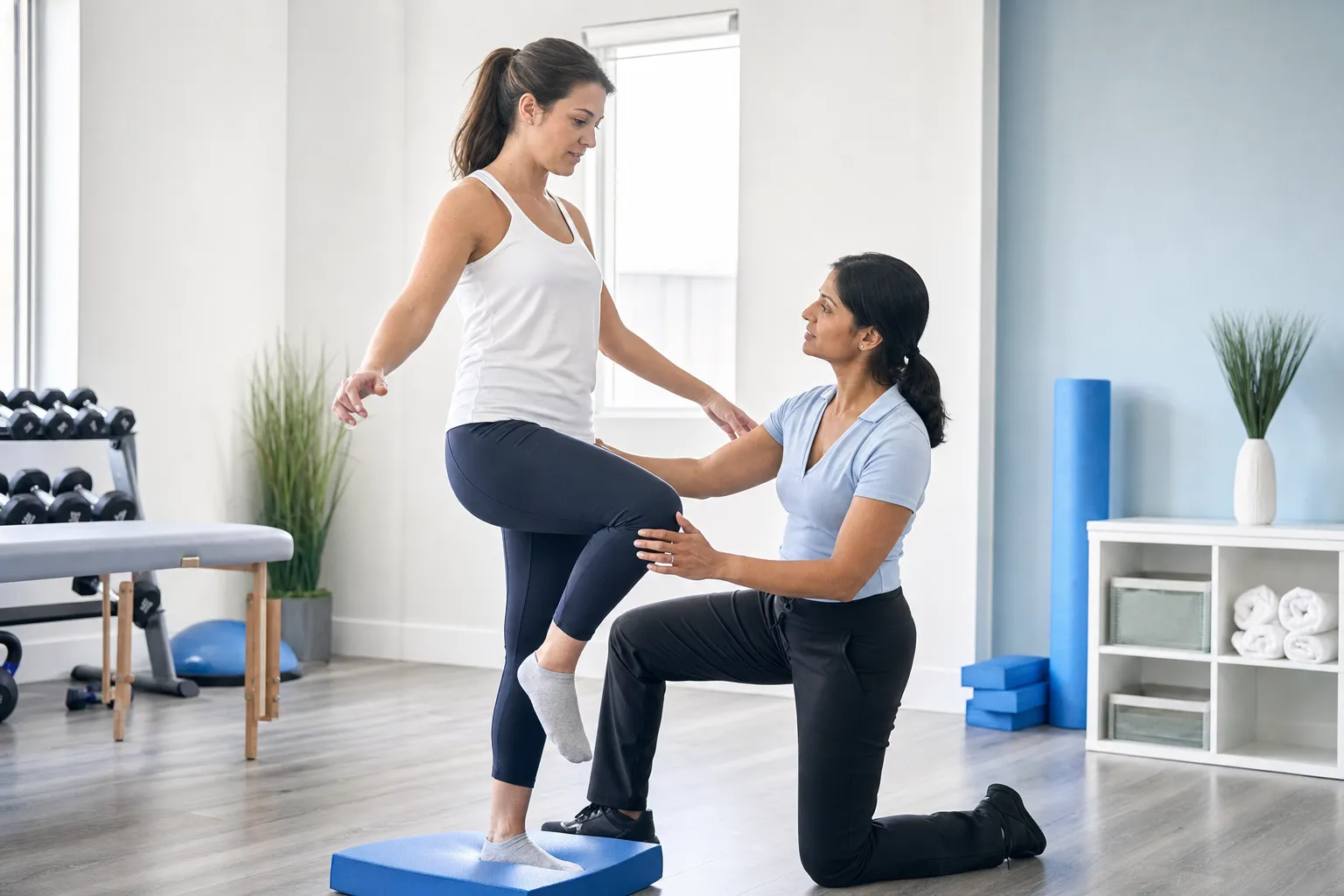
If you've been to physical therapy before, you may have had an experience like this: you arrive, a therapist greets you briefly, sets you up on a machine or hands you a sheet of exercises, and then disappears to juggle two or three other patients at the same time. An aide or technician checks on you now and then. You may even see a different therapist on your next visit.
Some clinics work this way, but it isn't the only way.
To be fair, research has not shown that any one format of physical therapy is best for everyone. Studies comparing supervised group programs with one-on-one physical therapy have generally found similar results. A review of 14 randomized trials in people with back, neck, knee, or shoulder pain found only small differences in pain and disability between group and individual physical therapy programs that included exercise, too small to matter clinically.[1] More recent research, much of it small and low in quality, points the same way.[2][3] But several things one-on-one care is built around have been linked with better outcomes: seeing the same therapist each visit,[4][5] an individually designed, supervised exercise program,[6] and a strong working relationship with your therapist.[7]
What "One-on-One" Actually Means
True one-on-one physical therapy means your therapist is focused on you for your entire session. Not splitting attention between several patients. Not handing your treatment to an aide. Not reading your chart for the first time because someone else saw you last week.
At Spineck Physical Therapy in East Brunswick, that's the whole model. The clinic is owner-operated, so you see the same experienced therapist every visit, start to finish. Your program is adjusted in real time based on how you respond that day.
Why It Can Make a Difference
- Continuity: When the same therapist treats you every visit, they know your history, your goals, and how you responded last time. In a US study of insurance claims for low back pain, people who had more consistent care from the same physical therapist were less likely to have back surgery and had lower back-pain-related costs.[4] In an Australian study of injured workers with low back pain, more continuity with one physiotherapist was linked with less time off work.[5] These are observational studies, so they show an association, not proof that continuity caused the difference.
- Individualized, supervised exercise: A review of 43 trials in chronic low back pain found that exercise programs designed for the individual and delivered with supervision may improve pain more than exercising at home on your own (supervised group programs also did better than exercising at home alone).[6] One-on-one sessions let your therapist watch how you move and adjust your program as you go.
- Trust: A review of 13 rehabilitation studies found that a stronger working relationship between patient and therapist was linked with better outcomes, including greater treatment satisfaction in people with musculoskeletal conditions and better physical function in people with chronic low back pain.[7]
Questions to Ask Before You Book Anywhere
You don't have to take any clinic's word for it. Here are honest questions that reveal how a practice really operates:
- Will I see the same therapist every visit, or does it rotate?
- Will my therapist be treating other patients during my session?
- Will aides or technicians be running part of my treatment?
- How much hands-on time will I actually get with a licensed therapist?
- Does the therapist have any specialty certifications for my condition?
The answers will tell you a lot. A practice built around individualized care will welcome these questions.
Specialty Care, Not Just Attention
Therapist training may matter, too. In a large observational study of more than 20,000 patients treated for low back pain, those whose physical therapists had any McKenzie training had slightly better function at discharge and needed slightly fewer visits (about 0.6 to 0.9 fewer) than those whose therapists had no McKenzie training.[8] However, outcomes and visit numbers did not differ significantly by how much McKenzie training the therapist had, including therapists who had reached the fully credentialed level.[8]
Spineck is led by a therapist with 15+ years of experience who is certified in the McKenzie Method (Cert. MDT). The McKenzie Method is a classification-based system that uses findings from your assessment to tailor an individualized exercise program.[9][10] For low back pain, the research is mixed. In chronic low back pain (lasting more than 12 weeks), a review of randomized trials found that McKenzie-based care reduced disability more than exercise alone, but not more than manual therapy combined with exercise.[9] For recent (acute or subacute) low back pain, it has not been shown to work better than other care, and a Cochrane review found its benefits too small to be clinically important.[9][10]
Experience the Difference in East Brunswick
Spineck Physical Therapy is located at 646 NJ-18 North, Suite 110 (Building B) in East Brunswick, serving patients throughout East Brunswick, South River, and surrounding towns.
If you'd prefer a session where your therapist is with you the whole time, call 551-208-3234 to schedule a one-on-one evaluation. You'll see the same therapist, start to finish, every visit.
References
- O'Keeffe M, Hayes A, McCreesh K, et al. Are group-based and individual physiotherapy exercise programmes equally effective for musculoskeletal conditions? A systematic review and meta-analysis. Br J Sports Med. 2017;51(2):126-132. doi:10.1136/bjsports-2015-095410 · PubMed
- Minor M, Plath E, Volland C, et al. Comparison of group and individual therapy in physiotherapy, occupational therapy, and speech therapy: a systematic review. Front Rehabil Sci. 2026;7:1904321. doi:10.3389/fresc.2026.1904321 · PubMed
- Dupuis F, Perreault K, Hébert LJ, et al. Group physical therapy programs for military members with musculoskeletal disorders: a pragmatic randomized controlled trial. J Orthop Sports Phys Ther. 2024;54(6):417-426. doi:10.2519/jospt.2024.12342 · PubMed
- Magel J, Kim J, Thackeray A, et al. Associations between physical therapy continuity of care and health care utilization and costs in patients with low back pain: a retrospective cohort study. Phys Ther. 2018;98(12):990-999. doi:10.1093/ptj/pzy103 · PubMed
- Gray SE, Tudtud B, Sheehan LR, et al. The association of physiotherapy continuity of care with duration of time loss among compensated Australian workers with low back pain. J Occup Rehabil. 2025;35(2):366-373. doi:10.1007/s10926-024-10209-8 · PubMed
- Hayden JA, van Tulder MW, Tomlinson G. Systematic review: strategies for using exercise therapy to improve outcomes in chronic low back pain. Ann Intern Med. 2005;142(9):776-785. doi:10.7326/0003-4819-142-9-200505030-00014 · PubMed
- Hall AM, Ferreira PH, Maher CG, et al. The influence of the therapist-patient relationship on treatment outcome in physical rehabilitation: a systematic review. Phys Ther. 2010;90(8):1099-1110. doi:10.2522/ptj.20090245 · PubMed
- Deutscher D, Werneke MW, Gottlieb D, et al. Physical therapists' level of McKenzie education, functional outcomes, and utilization in patients with low back pain. J Orthop Sports Phys Ther. 2014;44(12):925-936. doi:10.2519/jospt.2014.5272 · PubMed
- Lam OT, Strenger DM, Chan-Fee M, et al. Effectiveness of the McKenzie method of Mechanical Diagnosis and Therapy for treating low back pain: literature review with meta-analysis. J Orthop Sports Phys Ther. 2018;48(6):476-490. doi:10.2519/jospt.2018.7562 · PubMed
- Almeida MO, Narciso Garcia A, Menezes Costa LC, et al. The McKenzie method for (sub)acute non-specific low back pain. Cochrane Database Syst Rev. 2023;4(4):CD009711. doi:10.1002/14651858.CD009711.pub2 · PubMed
This article is for general education and is not a substitute for an individual evaluation by a licensed clinician.
Need Help With Your Condition?
If you're experiencing pain or have questions about physical therapy, schedule an appointment with our Certified McKenzie Therapist.
This article is for educational purposes only and is not a substitute for professional medical advice, diagnosis, or treatment. Always consult a licensed healthcare provider about your specific condition.