Neck Pain Treatment in East Brunswick, NJ: A McKenzie Method Approach

Medically reviewed by Devanshi Modi, PT, Cert. MDT, CMP — licensed physical therapist with over 15 years of clinical experience.
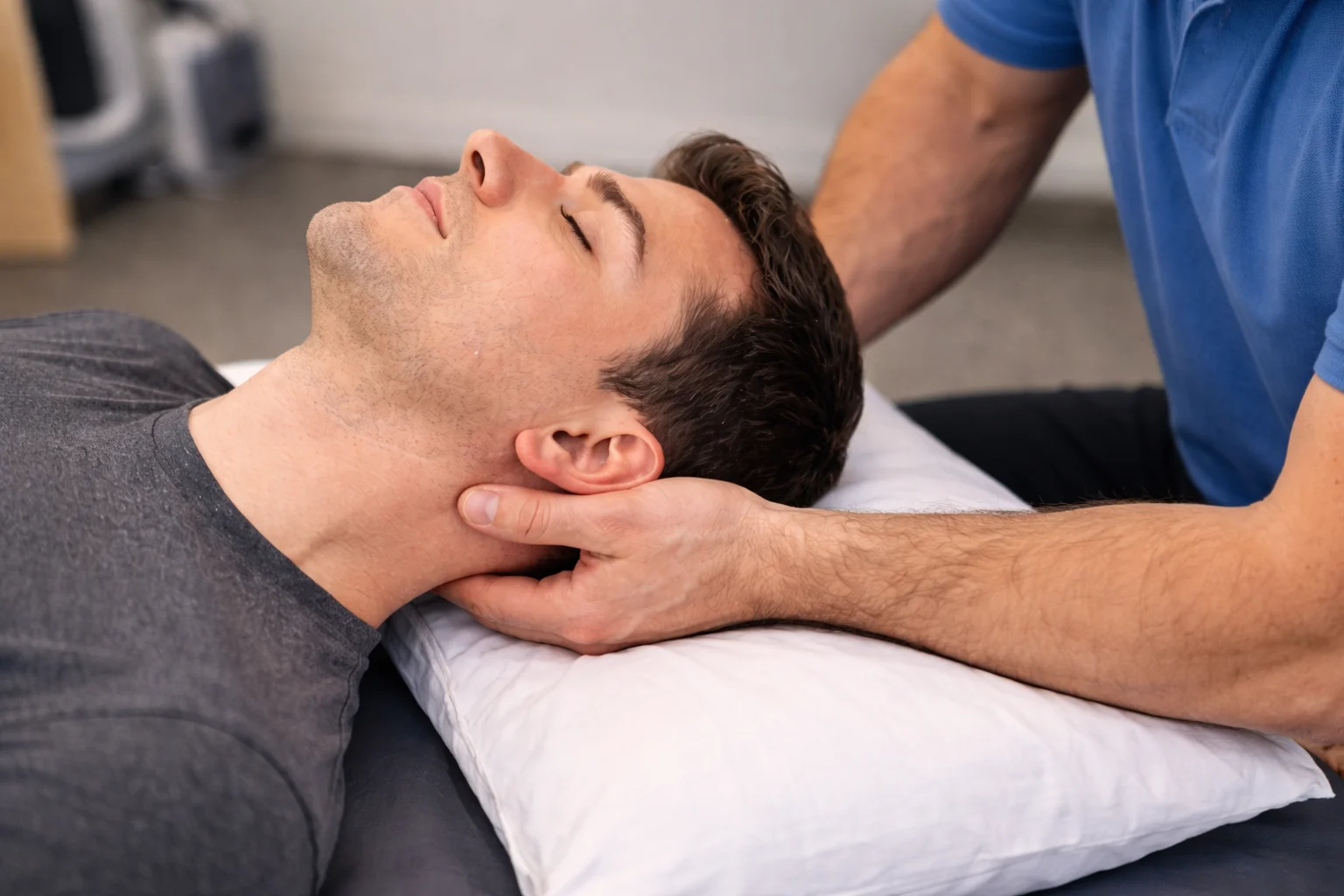
If you're dealing with neck pain in East Brunswick, you're not alone: neck pain affected an estimated 203 million people worldwide in 2020.[1] It is one of the most common conditions we treat at Spineck Physical Therapy, and residents throughout Middlesex County come to us seeking relief from ongoing stiffness, pain that travels into the arm, and headaches linked to the neck (such as cervicogenic headache).[2]
What Can Contribute to Neck Pain in East Brunswick Residents
Work-Related Factors
Many East Brunswick residents work in offices along Route 18 or commute to New Brunswick and Edison. In studies that followed office workers over time, a few factors were linked with a higher chance of developing neck pain:[3]
- A keyboard placed close to the body
- Little variety in work tasks
- Low satisfaction with the work environment
- Feeling moderate or high muscle tension
The evidence for other suspected physical risk factors was limited or conflicting.[3]
Herniated Discs
A herniated disc in the neck (cervical spine) that irritates a nerve root can cause:[4]
- Neck pain
- Pain that travels down one arm
- Weakness in the arm muscles
- Numbness or tingling in the fingers or hands
For more on herniated discs in the neck and lower back, including how they are assessed and how recovery usually goes, see our guide to herniated disc treatment in East Brunswick.
Sleep Position and Pillows
Waking up with a stiff or sore neck is often blamed on pillows or sleeping positions, but the research is still limited. In people with long-standing neck pain, a review of trials found that some pillow designs (rubber and spring pillows) modestly reduced neck pain and waking symptoms, and that a pillow's shape and height may affect how your neck is aligned.[5] There are not yet enough high-quality studies to say which sleeping positions are best for neck and back symptoms, although side-lying was generally linked with fewer symptoms in the few studies available.[6]
The McKenzie Method for Neck Pain
At Spineck Physical Therapy, we specialize in the McKenzie Method (Mechanical Diagnosis and Therapy, or MDT), a structured way of assessing how your neck responds to repeated movements and positions. For neck pain, the research is modest: a review of five trials found that MDT's extra benefit over other treatments, or over simply waiting, may not be clinically important for pain and was not clinically important for disability, although not all of the therapists in those trials had full McKenzie training.[7] In our clinic, this approach:
Looks for Your Movement Pattern
Not all neck pain is the same. During your assessment we test how your symptoms respond to repeated movements and positions, and use what we find to shape your personalized treatment plan. In studies of people with back or neck pain, about two in three had a direction of movement that eased their symptoms or drew them back toward the spine, while about a third had neither; for neck pain, the evidence that this response predicts recovery is limited.[8]
Empowers Self-Treatment
You'll learn exercises you can do at home, such as chin tucks (also called neck retractions), chosen based on how your neck responds. Gentle nodding exercises that train the deep muscles at the front of the neck (related to, but not the same as, a chin tuck) appear to reduce long-standing neck pain and improve function, although these studies did not test chin tucks themselves, vary in quality, and their findings are suggestive rather than definitive.[9] Exercise may also lower the chance of a new episode of neck pain: in trials of mostly office workers who did not have neck pain at the start, exercise programs probably reduced the risk of an episode over the following year, though how much difference this makes in practice is unclear, and these trials did not test whether exercise stops neck pain from coming back in people who already have it.[10]
Focuses on Exercise, Not Passive Treatments
A clinical guideline for neck pain lasting up to about six months lists education combined with exercise among the options clinicians may consider, and advises against some passive treatments, such as electrotherapy and clinic-based heat, because studies found them ineffective.[11] So rather than relying on passive treatments such as clinic-based heat or electrical stimulation, we focus on the movements and exercises your own neck responds to.
Why East Brunswick Residents Choose Spineck PT
True One-on-One Care
Every session at Spineck Physical Therapy is one-on-one with your therapist, with no aides and no double-booking, so you have your therapist's full attention for your entire appointment.
Convenient Location
Located at 646 NJ-18 North, Suite 110 (Building B), we're easily accessible from anywhere in East Brunswick. Free parking is available right outside our door.
Experienced, Certified Therapist
Our McKenzie Certified therapist, Devanshi Modi, has over 15 years of experience treating neck pain and cervical conditions.
When to Seek Treatment for Neck Pain
Neck pain often eases a lot over the first few weeks, but it does not always go away completely: in studies that followed people from the start of a new episode of neck pain, average pain was still 42 out of 100 a year later.[12] Consider an evaluation if you experience:
- Pain lasting more than a few days
- Numbness or tingling in your arm or hand
- Headaches that start at the base of your skull
- Difficulty turning your head
- Pain that wakes you at night
- Weakness in your arm or grip
If your symptoms keep getting worse, or new symptoms appear at any point, see a doctor for further evaluation.[11]
What to Expect at Your First Visit
- Detailed History - We'll discuss when your pain started, what makes it better or worse, and how it affects your daily life
- Physical Examination - Assessment of your posture, range of motion, strength, and neurological function
- Movement Testing - Checking how your symptoms respond to specific movements and positions
- Initial Treatment - Starting exercises chosen to begin easing your symptoms
- Home Program - Clear instructions for what to do between visits
Conditions We Treat
- Neck pain and stiffness
- Cervical herniated disc
- Cervical radiculopathy (pinched nerve)
- Cervicogenic headaches
- Whiplash injuries
- Postural dysfunction
- Degenerative disc disease
Take the First Step
Neck pain doesn't have to control your life. In studies that followed people from the start of a new episode of neck pain, including people who had little or no treatment, average pain fell by nearly half within about six weeks (from 64 to 35 on a 0 to 100 scale), although it often did not go away completely.[12] A clinical guideline advises reassuring people that common neck pain usually follows a benign (not dangerous) course, and stresses the importance of staying active and moving.[11] An evaluation can help you find the exercises and strategies that suit your neck.
East Brunswick residents: Call 551-208-3234 to schedule your neck pain evaluation at Spineck Physical Therapy.
References
- GBD 2021 Neck Pain Collaborators. Global, regional, and national burden of neck pain, 1990-2020, and projections to 2050: a systematic analysis of the Global Burden of Disease Study 2021. Lancet Rheumatol. 2024;6(3):e142-e155. doi:10.1016/S2665-9913(23)00321-1 · PubMed
- Côté P, Yu H, Shearer HM, et al. Non-pharmacological management of persistent headaches associated with neck pain: a clinical practice guideline from the Ontario Protocol for Traffic Injury Management (OPTIMa) Collaboration. Eur J Pain. 2019;23(6):1051-1070. doi:10.1002/ejp.1374 · PubMed
- Jun D, Zoe M, Johnston V, et al. Physical risk factors for developing non-specific neck pain in office workers: a systematic review and meta-analysis. Int Arch Occup Environ Health. 2017;90(5):373-410. doi:10.1007/s00420-017-1205-3 · PubMed
- de Rooij JD, Verhagen AP, Harhangi BS, et al. Nucleoplasty for cervical radicular pain due to disc herniation. Cochrane Database Syst Rev. 2025;11(11):CD011852. doi:10.1002/14651858.CD011852.pub2 · PubMed
- Pang JCY, Tsang SMH, Fu ACL. The effects of pillow designs on neck pain, waking symptoms, neck disability, sleep quality and spinal alignment in adults: a systematic review and meta-analysis. Clin Biomech (Bristol). 2021;85:105353. doi:10.1016/j.clinbiomech.2021.105353 · PubMed
- Cary D, Briffa K, McKenna L. Identifying relationships between sleep posture and non-specific spinal symptoms in adults: a scoping review. BMJ Open. 2019;9(6):e027633. doi:10.1136/bmjopen-2018-027633 · PubMed
- Takasaki H, May S. Mechanical diagnosis and therapy has similar effects on pain and disability as 'wait and see' and other approaches in people with neck pain: a systematic review. J Physiother. 2014;60(2):78-84. doi:10.1016/j.jphys.2014.05.006 · PubMed
- May S, Runge N, Aina A. Centralization and directional preference: an updated systematic review with synthesis of previous evidence. Musculoskelet Sci Pract. 2018;38:53-62. doi:10.1016/j.msksp.2018.09.006 · PubMed
- Javdaneh N, Mozafaripour E, Mohammadi A, et al. The effect of craniocervical flexor exercise on chronic neck pain: a systematic review and meta-analysis. Pain Manag. 2026;16(10):1171-1181. doi:10.1080/17581869.2026.2694373 · PubMed
- Teichert F, Karner V, Döding R, et al. Effectiveness of exercise interventions for preventing neck pain: a systematic review with meta-analysis of randomized controlled trials. J Orthop Sports Phys Ther. 2023;53(10):594-609. doi:10.2519/jospt.2023.12063 · PubMed
- Côté P, Wong JJ, Sutton D, et al. Management of neck pain and associated disorders: a clinical practice guideline from the Ontario Protocol for Traffic Injury Management (OPTIMa) Collaboration. Eur Spine J. 2016;25(7):2000-2022. doi:10.1007/s00586-016-4467-7 · PubMed
- Hush JM, Lin CC, Michaleff ZA, et al. Prognosis of acute idiopathic neck pain is poor: a systematic review and meta-analysis. Arch Phys Med Rehabil. 2011;92(5):824-829. doi:10.1016/j.apmr.2010.12.025 · PubMed
This article is for general education and is not a substitute for an individual evaluation by a licensed clinician.
Need Help With Your Condition?
If you're experiencing pain or have questions about physical therapy, schedule an appointment with our Certified McKenzie Therapist.
This article is for educational purposes only and is not a substitute for professional medical advice, diagnosis, or treatment. Always consult a licensed healthcare provider about your specific condition.