McKenzie Extensions: 6 Mistakes to Avoid (PT Guide)

Medically reviewed by Devanshi Modi, PT, Cert. MDT, CMP — licensed physical therapist with over 15 years of clinical experience.
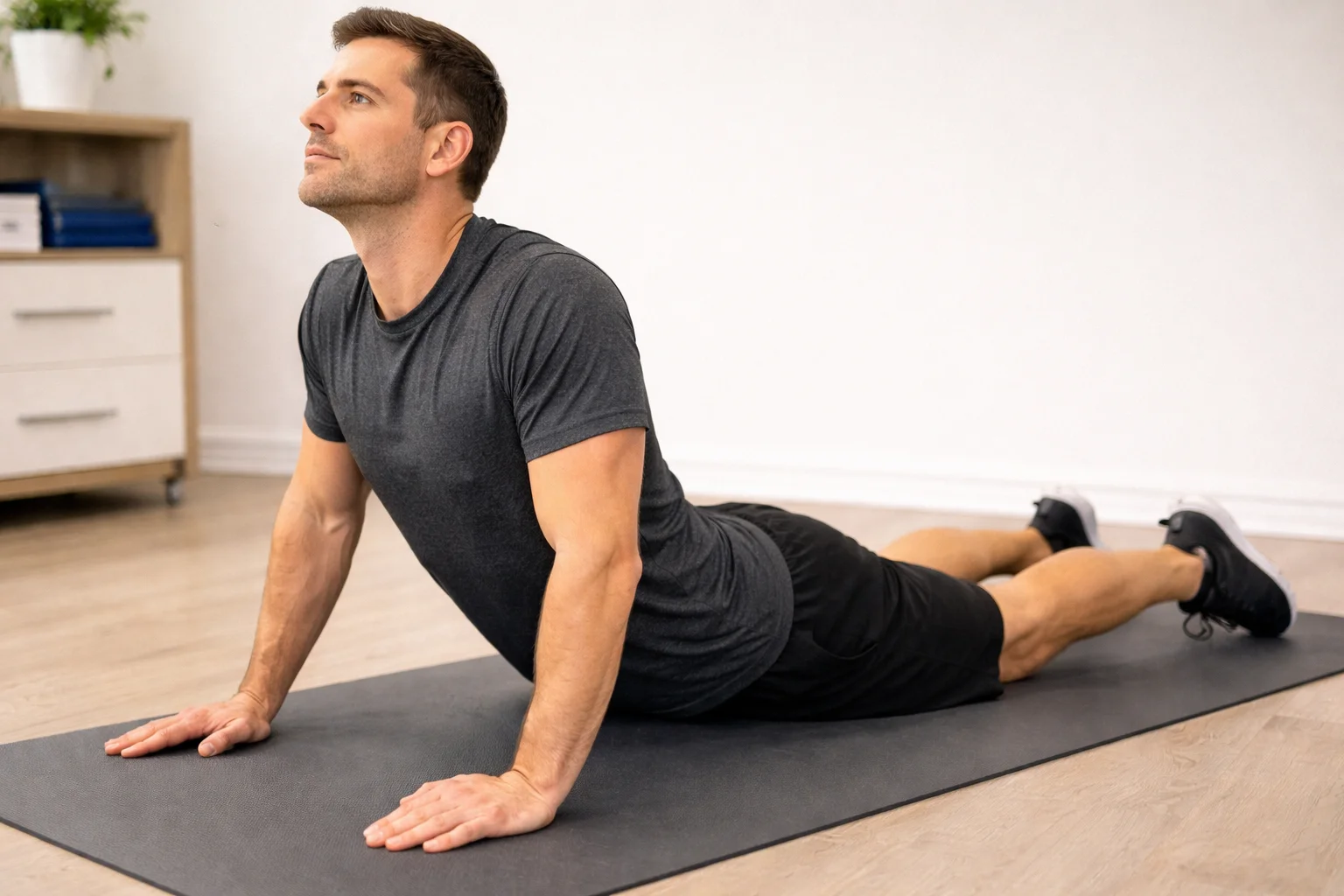
McKenzie lumbar extensions (also called prone press-ups) are repeated backward-bending exercises done lying face down. In the McKenzie approach they are mainly used for people whose back pain, or pain spreading into the buttock or leg, eases or moves toward the middle of the back when they bend backward repeatedly. The 2021 U.S. physical therapy guideline for low back pain lists the McKenzie approach (Mechanical Diagnosis and Therapy), which chooses repeated movements or positions based on how your symptoms respond, as an option therapists may use to reduce pain and disability, based on moderate evidence for long-lasting (chronic) low back pain and weaker evidence for recent (acute) low back pain.[1] For recent back pain, the guideline found no evidence that the McKenzie approach works better than other common treatments.[1] In one small trial of 48 people with back pain and symptoms below the buttock that moved back toward the spine with backward bending, an extension-focused physical therapy program (8 sessions plus home exercises) reduced back-related disability (how much pain limits daily activities) more than trunk-strengthening exercises at 1 week, 4 weeks and 6 months, although it eased pain more only at 1 week.[2] Not everyone has a direction of movement that helps: studies find no such response in about a third of patients,[3] so check with your therapist that extensions suit you. Here are mistakes we often see in our clinic when people do McKenzie lumbar extensions:
1. Using Back Muscles While Coming Up in Cobra Pose
In the McKenzie approach, the press-up is meant to be a relaxed (passive) backward bend for your lower back: your arms do the pushing while your back muscles stay as relaxed as possible. Because your arms do the lifting, in our experience some people notice their triceps (the muscles at the back of the upper arm) feel a little sore when they first start doing repeated press-ups. Arm-muscle soreness is different from your back or leg symptoms: if your back pain or leg symptoms get worse, stop and check with your therapist. In our clinic the goal we teach is to let your lower back bend backward without tightening the muscles along your spine.
2. Not Going to the End Range of Extension
In the McKenzie approach, each press-up is gradually taken a little further toward the end of the backward bend you can reach, as long as your symptoms are easing, moving toward the middle of your back, or staying the same. We are not aware of research that has tested whether reaching the very end of the range changes results. If press-ups make pain spread further into your buttock or leg, or leave you worse afterward, stop and check with your therapist, because backward bending may not be the right direction for you. In one trial of people with back pain who had a direction of movement that eased their pain, about a third of those given exercises in the opposite direction, or exercises not tied to a direction, dropped out within 2 weeks because they were not improving or were getting worse; no one doing exercises matched to their direction dropped out.[4]
In our clinic we cue people to breathe out at the top of each press-up and let the lower back sag; in our experience this helps many people relax into the position. This is a teaching cue rather than something research has tested.
3. Incorrect Position of Hand While Starting the Press Up
In our clinic we teach starting with your hands under your shoulders, as for a push-up. In our experience, placing the hands further forward (closer to your head) tends to shift more of the bend into the upper back rather than the lower back; we have not found research that measures this.
4. Leading the Movement with Neck Extension
Keep your neck relaxed and in line with your body rather than tipping your head back. In our clinic we teach it this way so the movement stays focused on your lower back.
5. Lifting Up the Pelvis
Keep the part of your body below your belt line resting on the table; in our clinic we teach this so the bend comes from your lower back.
6. Not Doing Them Regularly
In our clinic we usually suggest doing them 4-5 times a day (sets of 7-10 reps), or as advised by your McKenzie therapist. This is a starting routine rather than a proven dose: a 2026 review of exercise trials for ongoing (chronic) low back pain found that the evidence does not point to a single best exercise dose.[5]
In our clinic we also talk about how you sit, lift and move during the day. Keep in mind that research has found links between some postures or types of physical work and back pain but has not shown that they cause it.[6] In a review of prevention trials, exercise combined with education lowered the chance of an episode of back pain (moderate-quality evidence) and exercise alone may also help, while education on its own, back belts and shoe insoles did not appear to.[7]
To meet a certified McKenzie therapist in East Brunswick, call 551-208-3234 at Spineck Physical Therapy.
References
- George SZ, Fritz JM, Silfies SP, et al. Interventions for the management of acute and chronic low back pain: revision 2021. J Orthop Sports Phys Ther. 2021;51(11):CPG1-CPG60. doi:10.2519/jospt.2021.0304 · PubMed
- Browder DA, Childs JD, Cleland JA, et al. Effectiveness of an extension-oriented treatment approach in a subgroup of subjects with low back pain: a randomized clinical trial. Phys Ther. 2007;87(12):1608-1618. doi:10.2522/ptj.20060297 · PubMed
- May S, Runge N, Aina A. Centralization and directional preference: an updated systematic review with synthesis of previous evidence. Musculoskelet Sci Pract. 2018;38:53-62. doi:10.1016/j.msksp.2018.09.006 · PubMed
- Long A, Donelson R, Fung T. Does it matter which exercise? A randomized control trial of exercise for low back pain. Spine (Phila Pa 1976). 2004;29(23):2593-2602. doi:10.1097/01.brs.0000146464.23007.2a · PubMed
- Arora NK, Saueressig T, Schleimer T, et al. Optimal exercise dose in adults with chronic low back pain disorders: systematic review with dose-response network meta-analysis. Br J Sports Med. Published online September 24, 2026. doi:10.1136/bjsports-2026-111988 · PubMed
- Swain CTV, Pan F, Owen PJ, et al. No consensus on causality of spine postures or physical exposure and low back pain: a systematic review of systematic reviews. J Biomech. 2020;102:109312. doi:10.1016/j.jbiomech.2019.08.006 · PubMed
- Steffens D, Maher CG, Pereira LS, et al. Prevention of low back pain: a systematic review and meta-analysis. JAMA Intern Med. 2016;176(2):199-208. doi:10.1001/jamainternmed.2015.7431 · PubMed
This article is for general education and is not a substitute for an individual evaluation by a licensed clinician.
Need Help With Your Condition?
If you're experiencing pain or have questions about physical therapy, schedule an appointment with our Certified McKenzie Therapist.
This article is for educational purposes only and is not a substitute for professional medical advice, diagnosis, or treatment. Always consult a licensed healthcare provider about your specific condition.